

Heraldry: Heraldry 101
Throughout history various rulers, tribes and societies have represented themselves using all sorts of symbolism. In the European high middle ages, knights painted their shields with simple and striking figures in contrasting colors to distinguish themselves on the battlefield. These designs were interchangeable and not necessarily personal.
As the twelfth century progressed, these designs became more individualized and lasting, marking the birth of what we now call heraldry.
The art of heraldry grew beyond mere identification to become an integral part of knightly tournaments. Knights not only painted their shields but also adorned their surcoats and helmets with their heraldic device. Heralds, who were messengers of the nobility, even wore surcoats featuring their masters’ arms (or heraldic symbols), giving rise to the word heraldry itself.
Initially, individuals took up their arms freely, but in many places, monarchs eventually claimed the unique right to grant them.
The designs of arms had many inspirations. For warriors they could be the functional elements already upon their shields: nails, ridges and crosses. For people of a certain profession relevant devices could be used. The clergy could opt for religious attributes whereas a blacksmith might choose for a hammer. A particularly fun source of inspiration is the surname itself. A family named Keys could, for example, put several keys on their shield. These are called "canting arms".
As tournaments waned in popularity, heraldry mostly served the purpose of identification, leading to increasingly complex designs. More intricate drawings of woodwork framed the shield, and the nobility developed a taste for excessive quartering. By the turn of the 19th century all pretense of simplicity and clarity was abandoned in favor of what we now call landscape heraldry. This term refers to the use of detailed landscapes in proper colors on shields, as well as other picturesque scenes that are impossible to blazon (to write down in formal notation).
Blazon and other heraldic jargon
A blazon is a description of a coat of arms in a concise and formalized jargon. One first describes the field, namely its colors and divisions. Then the figures that appear on it are described.
The precise location of figures on the shield can be designated using the words "dexter" and "sinister," which mean "right" and "left" respectively. These words still have a place in our modern vocabulary. When someone is skillful and nimble, we refer to them as "dexterous." However, due to silly superstitions surrounding left-handedness, "sinister" has taken on a negative connotation and is now synonymous to the words ominous and evil. It is important to note that these terms are used from the perspective of the person holding the shield, which means that right and left are reversed. To make things simpler, translations for blazons will use the standard left and right orientation. The upper part of the shield is called the chief, while the lower part is the base.
To be precise: a coat of arms is the design painted on a shield (in proper terminology called an "escutcheon"), or as the name still hints to, a surcoat. Together with the other elements surrounding the escutcheon, it forms the heraldic or armorial achievement. Even among heraldists, in common usage, the "coat of arms" often refers to the whole thing. A crest, however, specifically refers to the symbol that’s placed on top of the helmet, as will be described later.
Colors
The colors used in heraldry, called tinctures by heraldists, are kept to a limited palette. This palette differs depending on the heraldic tradition, but a fairly conservative one in the English tradition is listed below.
| Name | Meaning |
|---|---|
| Metals | |
| Argent | Silver |
| Or | Gold |
| Tinctures | |
| Gules | Red |
| Azure | Blue |
| Sable | Black |
| Vert | Green |
| Purpure | Purple |
These strange words originate from the Norman French that came to England with William the Conqueror. They have survived in this context, not unlike how French words for types of meat survive in a culinary context (e.g. pork instead of pig meat).
Sometimes white is used as a heraldic color, distinct from Argent.
In addition to these tinctures, furs are also very commonly used in some traditions. The most common one is Ermine. This is depicted as a white field filled with black spots. This is meant to simulate clothing made of the winter fur of the stoat, which consist of white fur dotted by the black tips of the animal’s tail. Royal cloaks and crowns were often lined with this material.
A rule in heraldry, though one that is not always followed, is that one should never put color on color, or metal on metal.
Imaginary heraldry
It was not long before people began designing coats of arms for historical figures predating the rise of heraldry, as well as to fictional characters. King Arthur and the Knights of the Round Table were popular subjects, and they’ll be discussed later in this work, though any literary character was fair game.
Since people came up with these themselves, these weren’t standardized at first. They were as diverse and varied as the imaginations that birthed them. Over time, certain arms did begin to gain widespread acceptance and became strongly associated with their respective characters.
Anatomy of the heraldic achievement
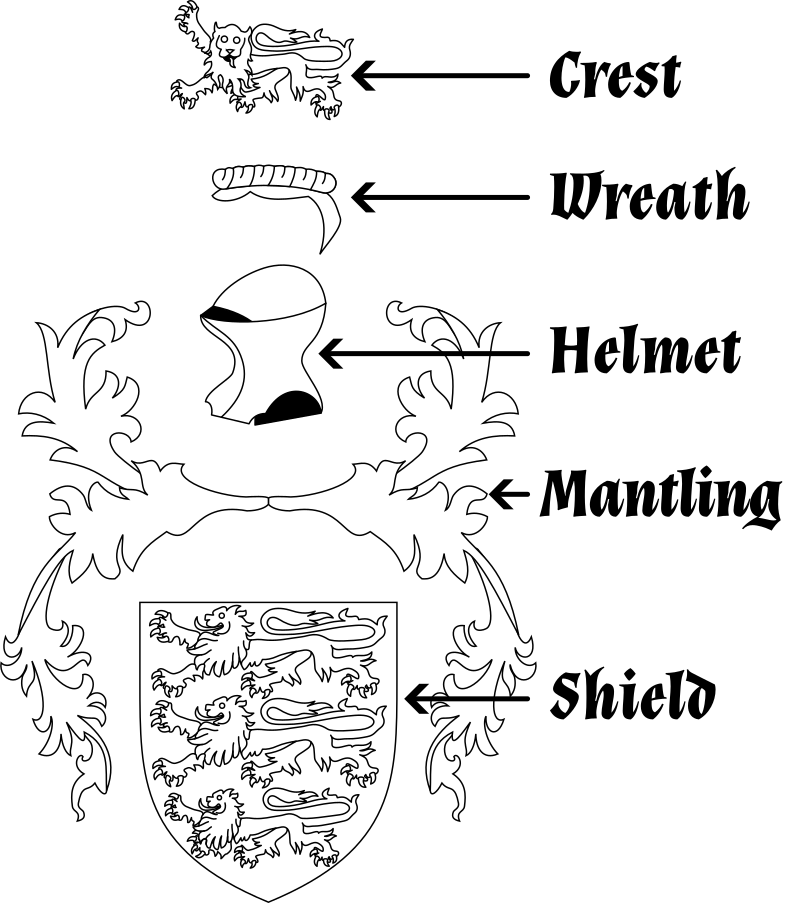
The crest
During tournaments, knights added a personal touch by wearing a decorative sculpture on top of their helmets. This sculpture, known as a crest, could be different from what was displayed on the shield. This practice has carried over into the art of heraldry.
The crest is often connected to the helmet by a fabric wreath (sometimes called torse), from which the mantling drapes around the helmet and shield. For nobility and royalty, the wreath is replaced with various types of crowns, adding some grandeur to their coats of arms.
Sometimes the crest and wreath were displayed by themselves, somewhat like a badge representing the individual.
The helmet
The shield usually has a knightly helmet resting atop it. The style of helmet can be as varied as the individuals they represent, reflecting either their rank or personal preference, depending on the local tradition.
In recent times a certain playfulness has arisen in heraldry, a trend has been particularly noticeable in Canada. For instance, when Julie Payette, a former Canadian astronaut, assumed her coat of arms, she chose to replace the traditional knight’s helmet with the helmet of a spacesuit, paying homage to her career in space exploration. Other examples include the use of contemporary defensive headgear, as well as headgear from non-European cultures.
A particularly poignant example in context of Disney heraldry we find on the facade of Mr. Toad’s Wild Ride in Disneyland and of Toad Hall Restaurant in Disneyland Paris. While what is actually depicted on both shields is comparable to 19th century landscape heraldry described earlier in this chapter, the helmet stands out. It is ingeniously designed to fit the shape of Mr. Toad’s head, which adds an element of whimsy and charm.
What do we see on the shield?
Ordinaries
When it comes to heraldic shields, the most fundamental ones are called ordinaries. They are simple shapes that can be found on the shield, and they come in various forms such as bands and crosses. Their orientation can also vary.
Charges
Charges are illustrations added to the shield. They can take on various shapes and sizes and be placed directly on the shield or on top of an ordinary. From animals, both real and mythical, to people and objects, charges are used to represent everything from personal traits to historical events. These emblems can be used individually or repeated in a pattern throughout the design.