

Heraldry: The Disney coat of arms
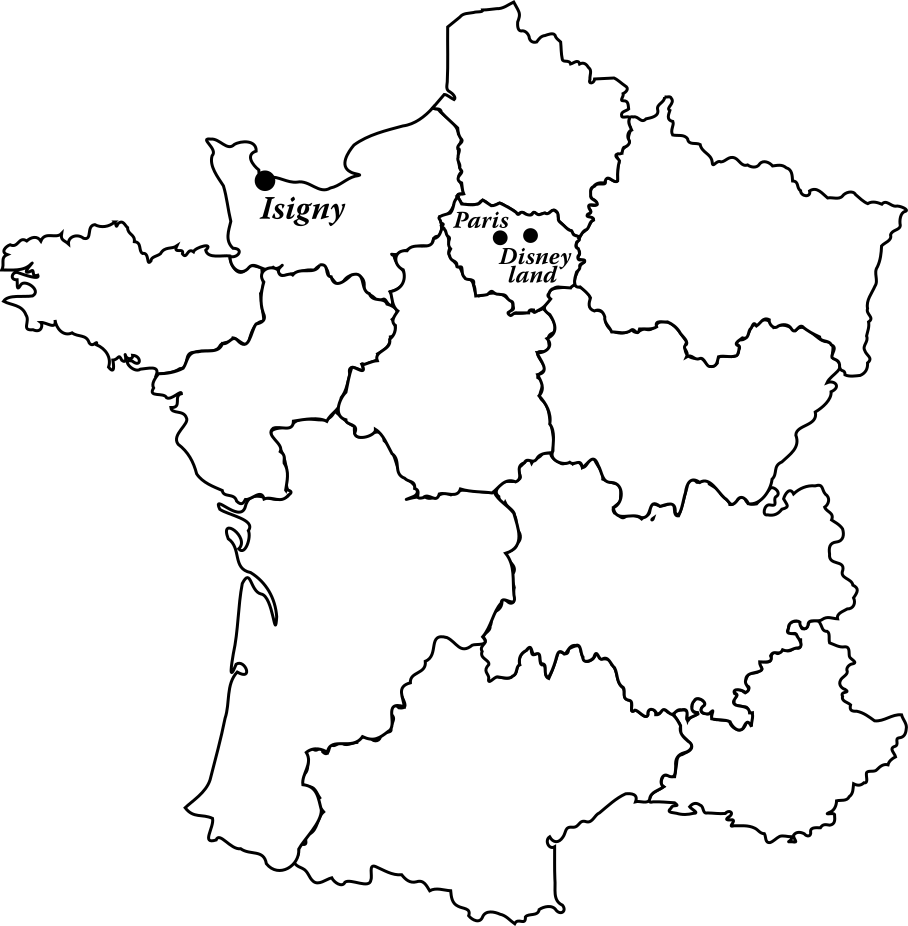
Delving into the origins of the Disney family takes us back to the quaint and charming Norman village of Isigny-sur-Mer, situated in a north-western corner of France. A branch of the d’Isigny (simply meaning “from Isigny” in French) family migrated to the British isles, with their name gradually transforming over time to d’Isney and ultimately, Disney.
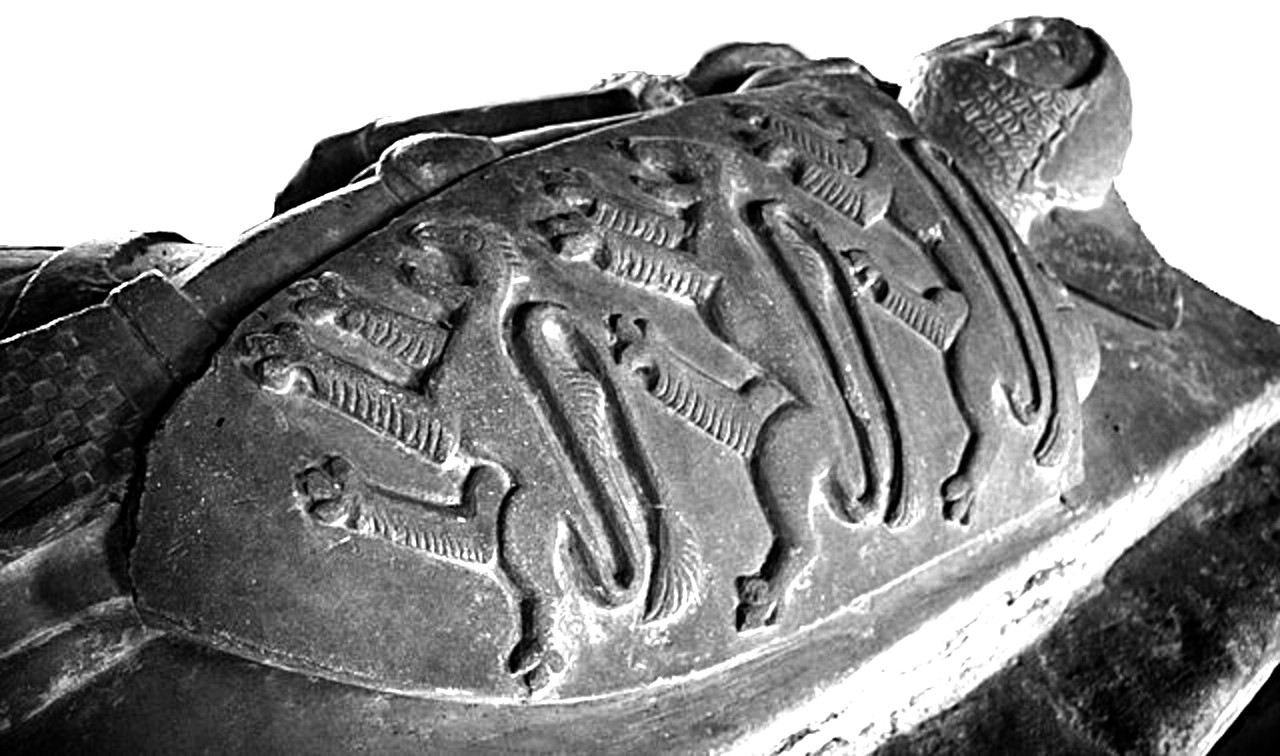
Photo by Richard Croft (CC-BY-SA)
In the English village of Norton Disney, one can find a fascinating piece of history within the local church. There lies a tomb effigy (a figure of the deceased on top of a tomb) of the 13th century knight William d’Isney, complete with a shield featuring three passing lions. In 1949 Walt himself visited the village to explore this possible part of his heritage.1
A stained glass panel discovered in Flintham tells us what the colors of this coat of arms likely were. Flintham Hall once belonged to the Disney family, and the glass panel showcases the a quartering of the arms inherited by the family. One of these quarters shows the three lions.2
“Argent, three lions passant gules” in the jargon of the heraldists, known as a blazon. Three walking red-colored lions on a white field. The crest of the quartered arms shows a “lion passant guardant gules”, which is the same red lion, but looking at the viewer this time.
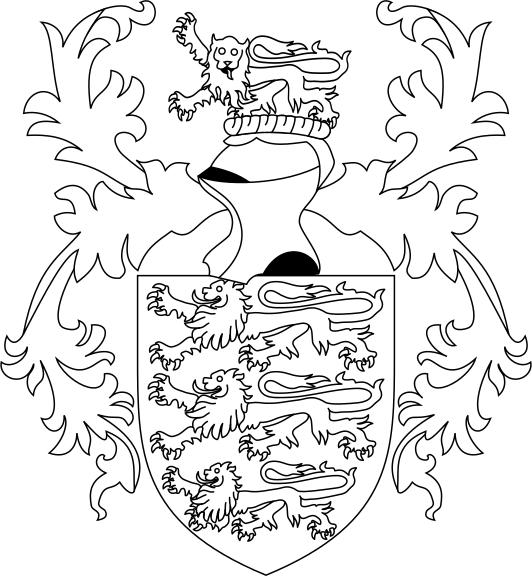
It is this specific coat of arms that Walt Disney and his imagineers eventually claimed for Walt and his kingdom. Under British heraldic laws, Walt would not be entitled to this coat of arms at all. The coat of arms is individual, and is passed on from father to eldest son. However, this is not the case in all heraldic traditions. And more importantly, Walt Disney was an American citizen.
Since 2006, Disney movies open with a castle sequence, prominently featuring an all-gold version of the Disney coat of arms on its flag. Isigny is nowadays renowned for its dairy farms, and Walt’s distant origins there are playfully nodded to in the fancy restaurant Walt’s in Disneyland Paris, which uses butter and cream from Isigny.
Notes
-
Jon Winter, “Uncle Walt’s lost ancestors”, The Independent (April 11, 1997), https://www.independent.co.uk/travel/uncle-walt-s-lost-ancestors-1266622.html↩︎
-
Geoffrey Lane, “A New Attribution to Henry Gyles”, Vidimus 82 (July/August 2014), https://vidimus.org/issues/issue-82/feature↩︎