
Heraldry: The Knights of the Round Table
As mentioned in the chapter on Imaginary Heraldry, designing coats of arms for the knights of the round table was a popular pastime for heraldists. These knights come from the same Arthurian legends that inspired Disney’s 1969 animated feature The Sword in the Stone. Imagineers also drew from this tradition in two carrousels themed after the knights of the round table.
The first carrousel covered is the King Arthur Carrousel, situated in Disneyland’s Fantasyland. First opened together with the park in 1955, it was originally built in 1922 before being reimagined by the imagineers. The second carrousel is the Lancelot Carrousel located in Disneyland Paris, which made its debut alongside its park in 1992.
The arms of both carrousels are listed counter-clockwise from starting from the banner or shield to the right of the entrance. To keep the overviews relatively uncluttered, short biographies of the knights to whom these may be ascribed are collected in a third section.
King Arthur Carrousel
The designers have generally tended to replace blue and perhaps even
green with purple, and all instances of gold with silver.
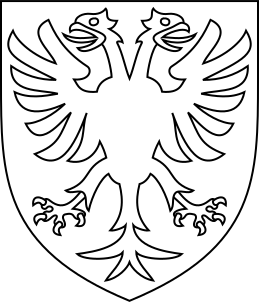 |
Blazon: “Purpure, a
double-headed eagle argent, armed, langued and beaked gules.” Translated: On a purple field, a silver double-headed eagle with its claws, tongue and beak in red. Sir Gawain |
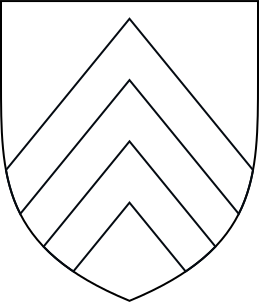 |
Blazon: “Gules, two
chevrons argent.” Translated: On a field of red, two silver chevrons. The original painted colors were gold and red. Neither depiction corresponds to historical examples of Arthurian heraldry. |
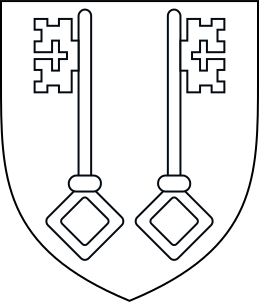 |
Blazon: “Purpure,
two keys argent addorsed.” Translated: On a field of purple, two silver keys back to back. Sir Kay, an example of canting arms. |
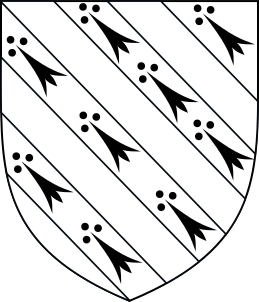 |
Blazon: “Bendy of
ermine and gules.” Translated: Alternating stripes in ermine and red. Sir Bors the Younger. |
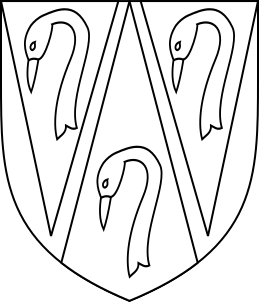 |
Blazon: “Party per
pile reversed argent and azure two piles purpure and three swan heads
argent erased.” Translated: A silver field with three long triangles cutting in. Two purple ones from above, one blue one coming from below. On all the triangles a swan’s head is placed. The swan heads might indicate Lohengrin, the swan knight. |
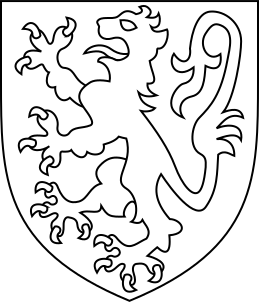 |
Blazon: “Purpure, a
lion rampant or langued and armed gules.” Translated: On a field of purple, a silver lion with red tongue and claws. The original color of the field was green, this would make it Sir Tristan. With the current coloring it is closest to Sir Yvain. |
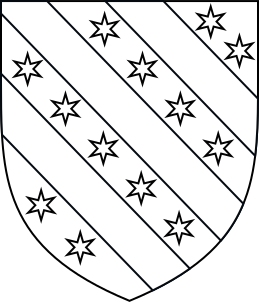 |
Blazon: “Argent,
semy of stars azure, three bendlets gules.” Translated: On a field of silver dotted with blue stars, three diagonal red stripes. Sir Lionel. |
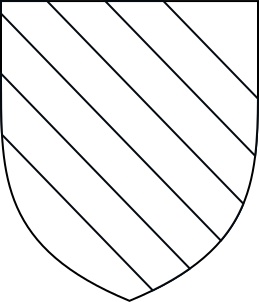 |
Blazon: “Argent,
three bendlets gules.” Translated: On a field of silver, three diagonal red stripes. Sir Lancelot. |
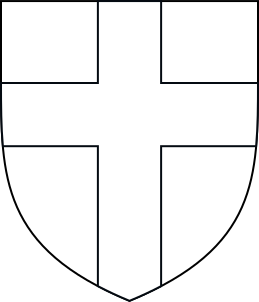 |
Blazon: “Gules, a
cross argent.” Translated: On a field of red, a silver cross. Originally, the colors of this shield were inverted. In either case, Sir Galahad is who this shield belongs to. |
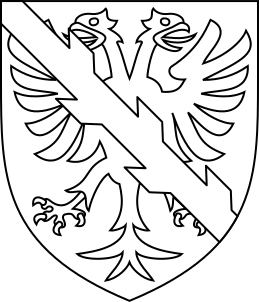 |
Blazon: “Purpure, a
double-headed eagle argent, armed, langued and beaked gules, over all a
trunk gules in bend.” Translated: On a purple field, a silver double-headed eagle with its claws, tongue and beak in red. A red saw-toothed diagonal line is placed over it. Sir Gareth. |
Lancelot Carrousel
In Paris the arms are more fanciful, and seldom fit a known knight.
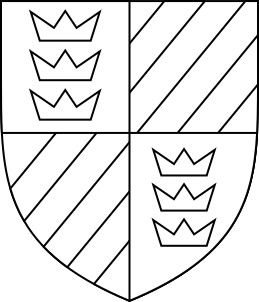 |
Blazon: “Quarterly
gules and bendy sinister azure and argent, in the first and fourth
quarter three coronets or in pale.” Translated: In the top left and bottom right quarters three stacked golden crowns on a red field. In the top right and bottom left quarters alternating stripes of blue and silver. The three crowns are traditionally ascribed to King Arthur. |
|
Blazon: “Azure
ermined or, four bendlets gules.” Translated: On a blue field with golden ermine spots, four red stripes. Sir Bors the Younger. |
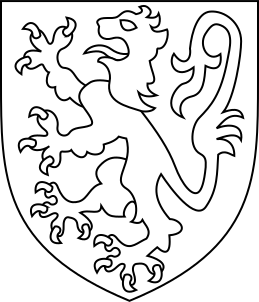 |
Blazon: “Purpure, a
lion argent, its head azure.” Translated: On a field of purple, a silver lion with a blue head. Unclear |
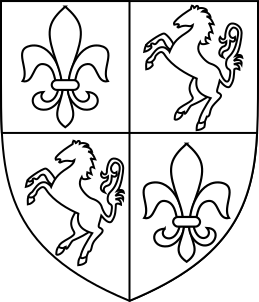 |
Blazon: “Quarterly
azure and argent, in the first and fourth quarter a fleur-de-lys argent,
in the second and third quarter a horse forcené purpure.” Translated: In the top left and bottom right quarters a silver fleur-de-lys on a blue field. In the top right and bottom left quarters a prancing purple horse on a silver field. Unclear |
|
Blazon: “Azure, a
double-headed eagle argent.” Translated: On a field of blue, a silver double-headed eagle.. Sir Gawain. |
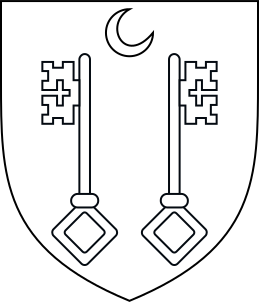 |
Blazon: “White, a
moon decrescent or in chief, two keys argent addorsed.” Translated: On a field of purple, two silver keys back to back underneath a crescent moon. Sir Kay. |
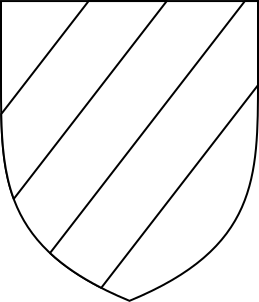
|
Blazon: “Argent,
two bendlets sinister purpure.” Translated: On a field of silver, two purple diagonal stripes. Sir Lancelot. It also appears above the name of the attraction, with proper red stripes. |
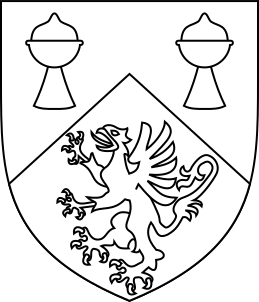 |
Blazon: “Per
chevron purpure and azure, 2 covered cups or in chief, a griffin rampant
or in base.” Translated: On a triangle coming from the bottom of shield a golden griffin. Above, on both sides of the triangle a golden covered cup. Unclear |
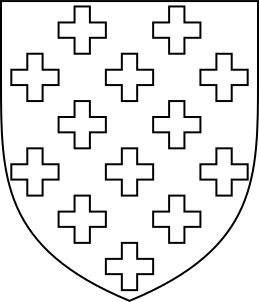 |
Blazon: “Purpure,
semy of greek crosses or.” Translated: A purple field dotted with golden plus signs. Sir Percival. |
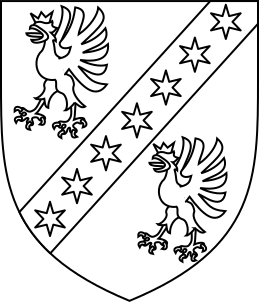 |
Blazon: “Per bend
sinister celestial-azure and gules, on a bendlet sinister azure 7 stars
argent, in second and third quarter a crowned eagle wings addorsed and
inverted or.” Translated: A diagonal blue stripe with seven golden stars on it. Above the stripe the field is light blue, below it is purple. On both sides there’s a crowned eagle facing leftwards. Unclear |
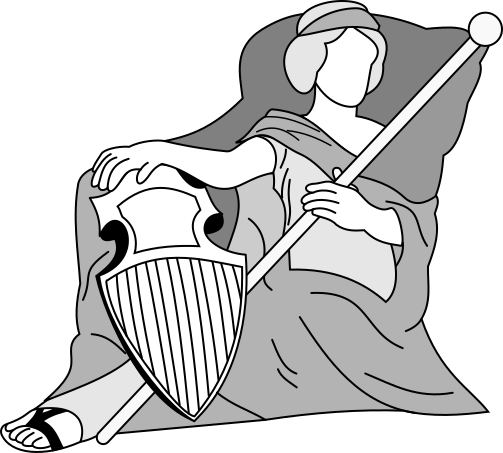
A delightful detail to note is the frequent depiction of Columbia, the personification of the United States, in the painted woodwork of the carrousel itself. Specifically the rounding board. She is portrayed holding the American coat of arms, the one also seen in the Great Seal of the United States.
The Knights
King Arthur
In the movie The Sword and the Stone, Arthur is depicted as a young boy. In the legends, he was fostered by Sir Ector and became a squire to Ector’s son Kay. One day, when other knights failed to pull a sword out of a stone, Arthur succeeded and proved himself to be the true king of England. This sword is usually identified as Excalibur.
The Legend of the Three Caballeros, an animated series featuring Donald Duck, has Arthur as an immortal anthropomorphic lion together with four of his knights. In human form, King Arthur appears in several episodes of Gargoyles.
There are various coats of arms that have been linked to King Arthur, but many of them feature three crowns.
Sir Kay
In Arthurian legend, Kay is known as King Arthur’s foster brother. In the movie The Sword and the Stone, he was portrayed as a bully, which is consistent with his depiction in other Arthurian tales where he is often seen as a mean buffoon. Despite his flaws, Sir Kay was known for his great strength.
In the Legend of the Three Caballeros, Kay is depicted as a female anthropomorphic ostrich.
Kay’s heraldic depictions usually involve keys, an example of canting arms.
Sir Lancelot
Lancelot was the right hand of King Arthur, and had many qualities befitting a good knight. Nonetheless, he falls in love with Arthur’s wife Guinevere and and instigates a civil war. Due to his sins, he also fails in his quest to find the Holy Grail. His own son Galahad did not share his father’s flaws, and became the epitome of knighthood, succeeding where his father did not.
Lancelot appears as a character in ABC’s Once Upon a Time. He also appears as an anthropomorphic horse in the Legend of the Three Caballeros.
He is most commonly depicted wearing white arms with three red diagonal stripes on them.
Sir Galahad
Galahad is Lancelot’s son. He was the first and only warrior the defeat his father in a fair fight. Virtuous and pure, he succeeds in finding the Holy Grail.
Fittingly, his arms are most commonly depicted as a red cross on a silver field.
He appears as a frog knight in the Legend of the Three Caballeros
Sir Bors the Younger and Sir Lionel
Bors the Younger and Lionel are the sons of Bors the Elder, who was the king of Gaunnes.
As one of the finest knights, Bors aided Galahad during the quest for the Holy Grail, but did not touch it himself. Lionel was unworthy, and even fought his brother.
Their traditionally attributed arms are similar: both have show three red diagonal stripes. For Bors these are placed upon a field of ermine, and for Lionel they’re placed upon a field dotted with black stars.
A dog knight named Bors appears in the Legend of the Three Caballeros, where he’s noted to have been recommended to change his title from “the Older” to “the Younger” by Arthur.
Sir Percival
The original hero of the grail, before later English and French stories brought in Galahad.
In the German stories, his son is Lohengrin, the swan knight.
The arms attributed to him consist of golden crosses on a purple field.
Sir Gawain and Gareth
The nephews of King Arthur.
Seeking to prove himself through his deeds rather than his blood, Gareth arrives at Camelot in disguise. As a kitchen boy he is bullied by Sir Kay, but soon proves his worth.
His older brother Gawain was initially one of the most handsome and courteous knights, but in later retellings his character is interpreted more negatively.
Gawain’s arms generally consist of a golden two-headed eagle on a purple field. Gareth’s is the same, with a diagonal red stripe to differentiate it.
Sir Ywain
Ywain was happily married, but his good friend and cousin Gawain convinces him to go on knightly quests with him. His wife assents but asks him to come back after a certain amount of time has passed. Ywain enjoys the quests so much, even acquiring a lion as a companion, that he forgets about his promise to his wife. Remorseful and struck with grief, she eventually forgives him.
A golden lion (referring to his companion) adorns his blue shield.
Sir Lohengrin
A character that appeared in German Arthurian legends. Lohengrin was the son of Percival, who became the grail king in the German tales. Knights of the Grail were sent out to secretly protect lordships without lords.
When the duke of Brabant died, Lohengrin arrived in a boat pulled by swans. He protected the duchess, under only one condition: she may never ask his name or origin. He served the duchy loyally, but eventually the duchess did ask the questions. After he answered, he departed forever.
The 19th century King of Bavaria Ludwig the Second was so enamored with this legend that he had a majestic castle built in reference to it: Neuschwanstein (New Swan Stone). This fairy tale castle served as the inspiration for Disneyland’s Sleeping Beauty castle.
Lohengrin’s symbol is, of course, the swan, which appears on heraldry attributed to him.
Sir Tristan
Sir Tristan is known for his tragic forbidden love for Isolde who was promised to his uncle, the King of Cornwall. The operatic whale Willie plays Tristan when we see a brief snippet of him performing the opera Tristan and Isolde in the 1946 animated short “The Whale Who Wanted To Sing At the Met”, a part of Make Mine Music.
Sources
-
Wilfrid Scott-Giles, “Uncle Walt’s lost ancestors”, Coat of Arms 64-65. (October 1965–January 1966), https://www.theheraldrysociety.com/articles/some-arthurian-coats-of-arms/